
Ocean Conservation Innovations: 2025
Many of us are drawn to the ocean for the way it supports our own health. Time near the water offers many positive benefits. What we have to remember is that this relationship works both ways. The health of our oceans is influenced by the choices we make on land and by how we interact directly with the sea.
What’s encouraging is that this understanding is already shaping how people build, design, and innovate. Over the past year, a wide range of new technologies and approaches have been introduced with ocean health in mind. Some focus on reducing pressure before it reaches the sea. Others operate directly within marine environments. Together, they reflect a growing effort to support ocean ecosystems through thoughtful, practical innovation.
To celebrate this positive momentum, let’s take a closer look at breakthroughs making a measurable difference for our seas.
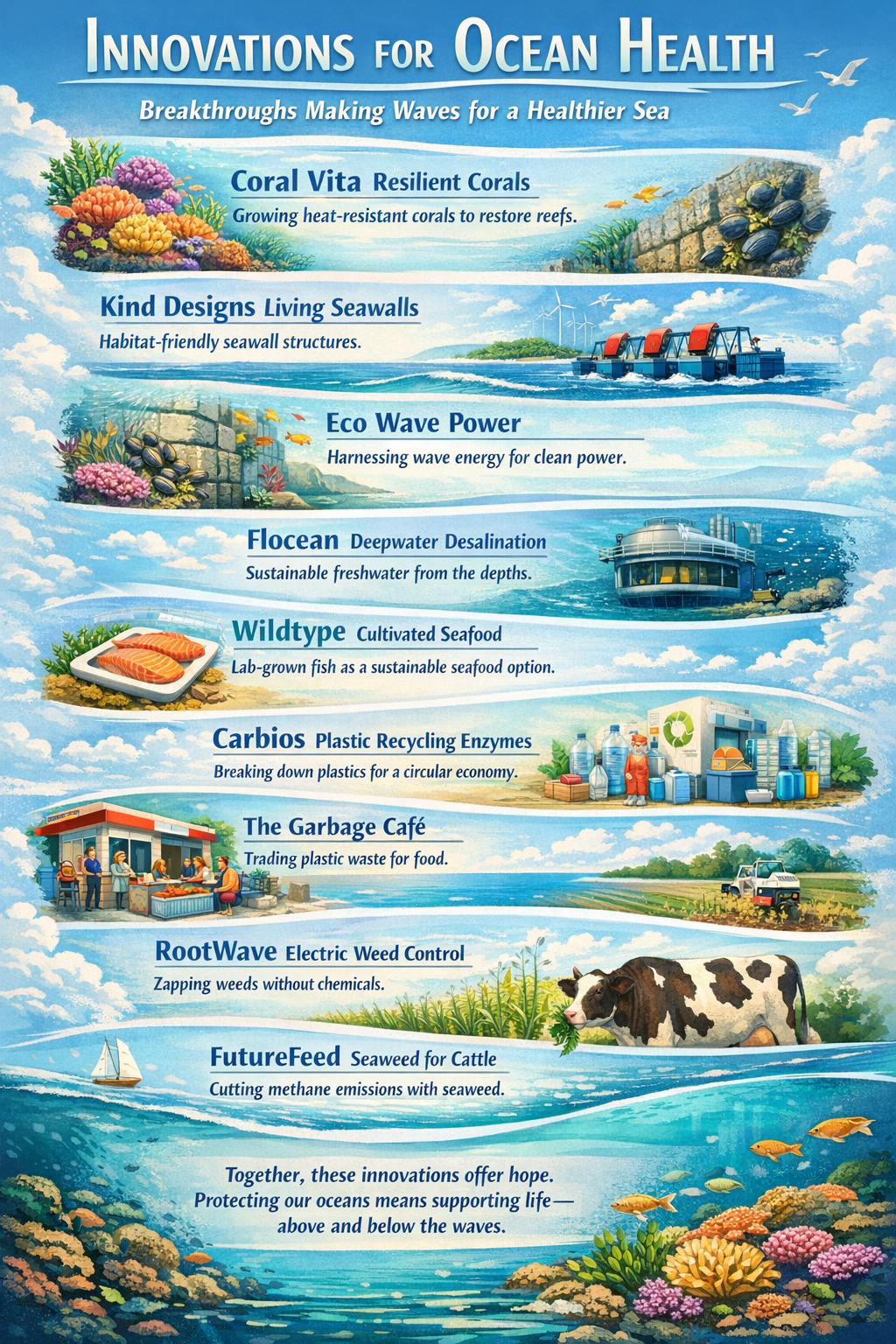
Coral Vita - Resilient Corals
Coral reefs support an enormous range of marine life and protect coastlines, but they are highly vulnerable to rising temperatures and environmental stress. Coral Vita is tackling the climate-driven collapse of coral reefs by growing corals faster and smarter than nature does on its own. By identifying which corals grow faster and tolerate heat better, restoration efforts can become more targeted and resilient, improving the chances that restored reefs will survive long term rather than requiring repeated intervention.
Kind Designs – Living Seawalls
Traditional seawalls protect coastlines but often strip away natural habitat. Living Seawalls approach coastal protection differently, using textured, modular surfaces designed to mimic natural rocky environments. These surfaces, commercialized by a company called Kind Designs, create space for oysters, mussels, seaweed, and other organisms to attach and grow, allowing marine life to coexist with necessary coastal infrastructure rather than being displaced by it.
Eco Wave Power
Ocean waves contain vast, untapped energy. Eco Wave Power captures that motion using floating devices attached to existing coastal structures and converts it into electricity that feeds directly into the grid. By generating renewable energy without drilling, dredging, or offshore platforms, wave power offers a way to reduce fossil fuel dependence while minimizing disruption to marine environments.
Flocean
Freshwater scarcity is becoming more common in coastal regions, yet traditional desalination plants are energy-intensive and environmentally disruptive. Flocean’s systems operate hundreds of meters below the ocean surface, using natural water pressure to push seawater through filtration membranes. This approach significantly reduces energy use and surface-level impact while providing a quieter, lower-footprint method of producing freshwater.
Wildtype
Seafood demand continues to rise while wild fish populations face increasing pressure. Wildtype produces salmon by growing fish cells in controlled environments rather than harvesting live fish from the ocean. FDA approval in 2025 marked a major milestone for cultivated seafood, signaling that alternatives to traditional fishing can safely enter the food system and help reduce strain on marine ecosystems.
Shinkei Systems – Poseidon
Shinkei Poseidon brings automation and precision to a centuries-old fish processing method known as ike-jime. Using computer vision and AI, the system identifies fish species and applies the correct humane technique instantly. This reduces stress on the fish, improves meat quality, and extends shelf life, which in turn reduces waste across the seafood supply chain and encourages more efficient use of harvested resources.
Carbios
Synthetic textiles are a significant source of microplastic pollution in waterways and oceans. Carbios uses engineered enzymes to break polyester down into its original components so the material can be reused repeatedly. This process supports a more circular materials economy and reduces the volume of plastic waste entering the environment from clothing and packaging.
The Garbage Cafe Model
Plastic pollution often begins far from the coast, moving through rivers and drainage systems before reaching the ocean. The Garbage Cafe model addresses this upstream by allowing people to exchange collected plastic for meals. It creates a direct incentive to remove waste from the environment while also supporting food access, demonstrating how community-scale solutions can have environmental impact beyond their immediate location.
RootWave
Chemical runoff from agriculture is a major contributor to water pollution that eventually reaches coastal ecosystems. RootWave replaces herbicides with controlled electrical currents that destroy weeds down to the root. By reducing chemical use, this approach helps protect rivers, estuaries, and marine life while supporting more resilient farming practices.
FutureFeed
Climate change remains one of the largest long-term threats to ocean health. FutureFeed uses a small amount of the seaweed Asparagopsis in cattle feed to significantly reduce methane emissions from digestion. Cutting methane at the source helps slow ocean warming and acidification, offering an indirect but meaningful benefit to marine ecosystems.
Why This All Matters
It’s easy to think of the ocean as something separate from everyday life. A place we visit on vacation. A backdrop. Somewhere beautiful, but distant. In reality, the ocean quietly supports much of what makes modern life possible. It regulates climate. It produces oxygen. It feeds billions of people. It shapes weather patterns and coastlines. And for many of us, its beauty supports something less measurable but just as real: our sense of calm, perspective, and well-being.
The innovations highlighted here matter because they recognize that connection. They acknowledge that human health and ocean health are not separate concerns. They move the conversation beyond abstract responsibility and into practical action. Each one addresses a specific pressure on ocean systems, whether that pressure comes from energy production, food supply chains, materials, agriculture, or coastal development.
What’s worth celebrating is not just any single breakthrough, but the pattern that emerges when you look at them together. These efforts show that protecting the ocean does not require choosing between progress and preservation. It requires designing smarter systems. Systems that reduce waste before it reaches the sea. Systems that work with marine environments instead of against them. Systems that allow people to meet real needs, for food, energy, water, and shelter, while placing less strain on ecosystems that have already given us so much.
This work also reminds us that solutions don’t all look the same. Some happen far inland, long before pollution or runoff ever reaches the coast. Others operate directly in the water, restoring reefs, supporting marine life, or generating clean energy from natural movement. Some are highly technical. Others are simple, community-driven ideas. All of them matter because they reflect intention.
This continues the idea that ocean protection doesn’t have to be limited to conservation alone. It is showing up in engineering labs, design studios, farms, fisheries, and cities. That shift matters because the ocean can’t be saved without a creative, multi-pronged approach.
Taken together, these innovations offer something genuinely hopeful. Proof that caring for the ocean is not just an environmental goal, but a human one.
